
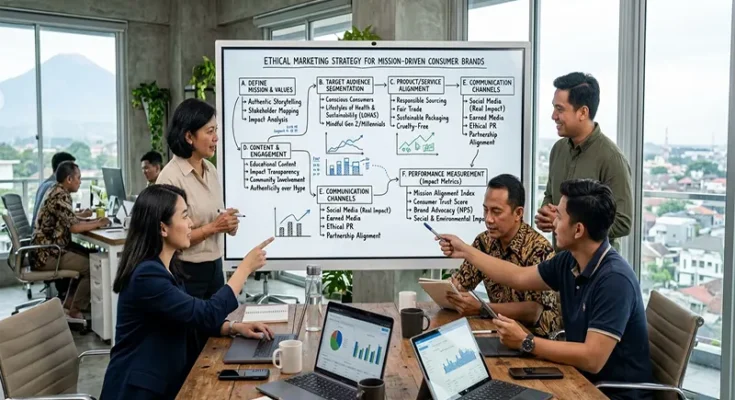
Ethical Marketing Strategy Development for Mission-Driven Consumer Brands

Ethical Marketing Strategy Development for Mission-Driven Consumer Brands

In 2026, the marketplace is defined by a profound “Trust Deficit.” The era of vague, feel-good “cause marketing” has ended, as Gen Z and Gen Alpha consumers—equipped with sophisticated AI-driven research tools—can detect “purpose-washing” in seconds. Traditional campaigns that treat ethics as an aesthetic layer are being rejected in favor of brands that demonstrate a Supply-Chain-to-Storytelling continuum.

The core thesis for a mission-driven brand is that ethical marketing is not a department or a seasonal campaign; it is a fundamental operational commitment. True brand integrity is found where the marketing message is an unedited reflection of the brand’s internal realities.

The Framework of Radical Transparency

To win in this environment, brands must transition from “Black Box” operations to “Glass Box” transparency.

The “Glass Box” Brand

A “Glass Box” brand is one that invites the consumer to look inside. This means going beyond high-level mission statements to provide SKU-level data. In …

Ethical Marketing Strategy Development for Mission-Driven Consumer Brands Read More

Integrated Sales and Marketing: Developing a Unified ABM Strategy

Integrated Sales and Marketing: Developing a Unified ABM Strategy

In the enterprise B2B environment of 2026, the traditional hand-off from Marketing to Sales is no longer just inefficient—it is a liability. Account-Based Marketing (ABM) has evolved from a niche marketing tactic into a Unified Revenue Motion. Companies that continue to operate in silos pay a “Silo Tax,” manifesting as inconsistent brand narratives, wasted ad spend on disinterested accounts, and missed expansion opportunities.

The core thesis of a modern integrated strategy is that ABM success is not measured by the volume of leads generated, but by the “Tightness of the Hand-off.” When Sales and Marketing act as a single unit, they move from catching fish with a broad net to a coordinated strike on high-value targets.

The Foundation: An Integrated ICP and TAL

The first step in breaking down silos is the collaborative creation of the Ideal Customer Profile (ICP) and the resulting Target Account List (TAL).

In …

Integrated Sales and Marketing: Developing a Unified ABM Strategy Read More
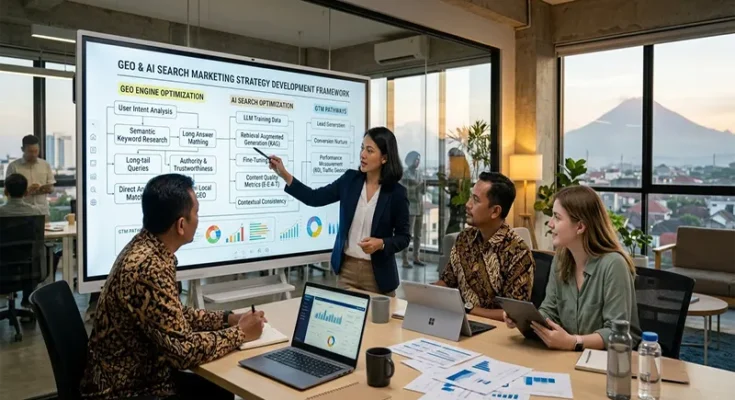
Marketing Strategy Development for Generative Engine Optimization (GEO) and AI Search

Marketing Strategy Development for Generative Engine Optimization (GEO) and AI Search

The digital marketing industry is currently navigating its most profound structural shift since the inception of the backlink. For three decades, the primary objective of search marketing was to secure a spot on the “Search Engine Results Page” (SERP). However, in 2026, the traditional SERP—a list of blue links—is becoming a relic of the past. It has been replaced by the Answer Engine.

Users are no longer searching for a list of resources to sift through; they are searching for a synthesized, definitive, and conversational response. This shift has necessitated the move from Search Engine Optimization (SEO) to Generative Engine Optimization (GEO). In this new paradigm, the goal is not just to be “found” by a crawler, but to be “ingested” by a model. To survive, brands must stop writing for a search algorithm and start informing the generative model.

The Architecture of AI Search: Understanding the LLM

Marketing Strategy Development for Generative Engine Optimization (GEO) and AI Search Read More
Predictive Analytics in Marketing Strategy: A Framework for Lead Scoring and Retention

Predictive Analytics in Marketing Strategy: A Framework for Lead Scoring and Retention

In the competitive landscape of 2026, the traditional marketing playbook is being rewritten. For years, marketing was reactive: teams waited for a lead to fill out a form before scoring them, or waited for a cancellation request before attempting a retention save. These methods are no longer sufficient. In an era of instant gratification and hyper-competition, Reactive Marketing is a cost center; Predictive Marketing is a revenue driver.

Traditional lead scoring—often based on arbitrary points for an email open—and “save-the-date” retention tactics are failing because they lack context and foresight. The core thesis of a 2026 growth strategy is that Predictive Analytics allows brands to see the future of a customer’s value before the customer even knows it themselves. By identifying patterns within massive datasets, predictive models anticipate needs, intent, and friction, allowing marketers to intervene with surgical precision.

Part I: Predictive Lead Scoring — Quality Over Quantity

The goal …

Predictive Analytics in Marketing Strategy: A Framework for Lead Scoring and Retention Read More
How to Build an AI-First Marketing Strategy Development Framework

How to Build an AI-First Marketing Strategy Development Framework

For the past decade, marketing leaders have treated artificial intelligence as a “bolt-on” utility—a faster way to write emails or a smarter way to bid on keywords. This “Legacy Plus AI” approach is rapidly hitting a ceiling of diminishing returns. As we navigate the 2026 landscape, the competitive frontier has shifted toward the AI-First paradigm.

An AI-First strategy is not defined by the number of LLM licenses a department holds, but by the extent to which AI serves as the foundation of the marketing engine. The core thesis of this shift is a move away from creative volume toward predictive precision. In an AI-First world, we do not simply create more content; we use an integrated intelligence layer to ensure that every touchpoint is a mathematically optimized response to a specific customer need, delivered at the exact moment of highest influence.

The 4 Pillars of the AI-First Framework

How to Build an AI-First Marketing Strategy Development Framework Read More